

Selling a home
Selling a house with an unauthorised veranda or canopy
 Davide Pavoni · FIAIP estate agent
· 3 min read
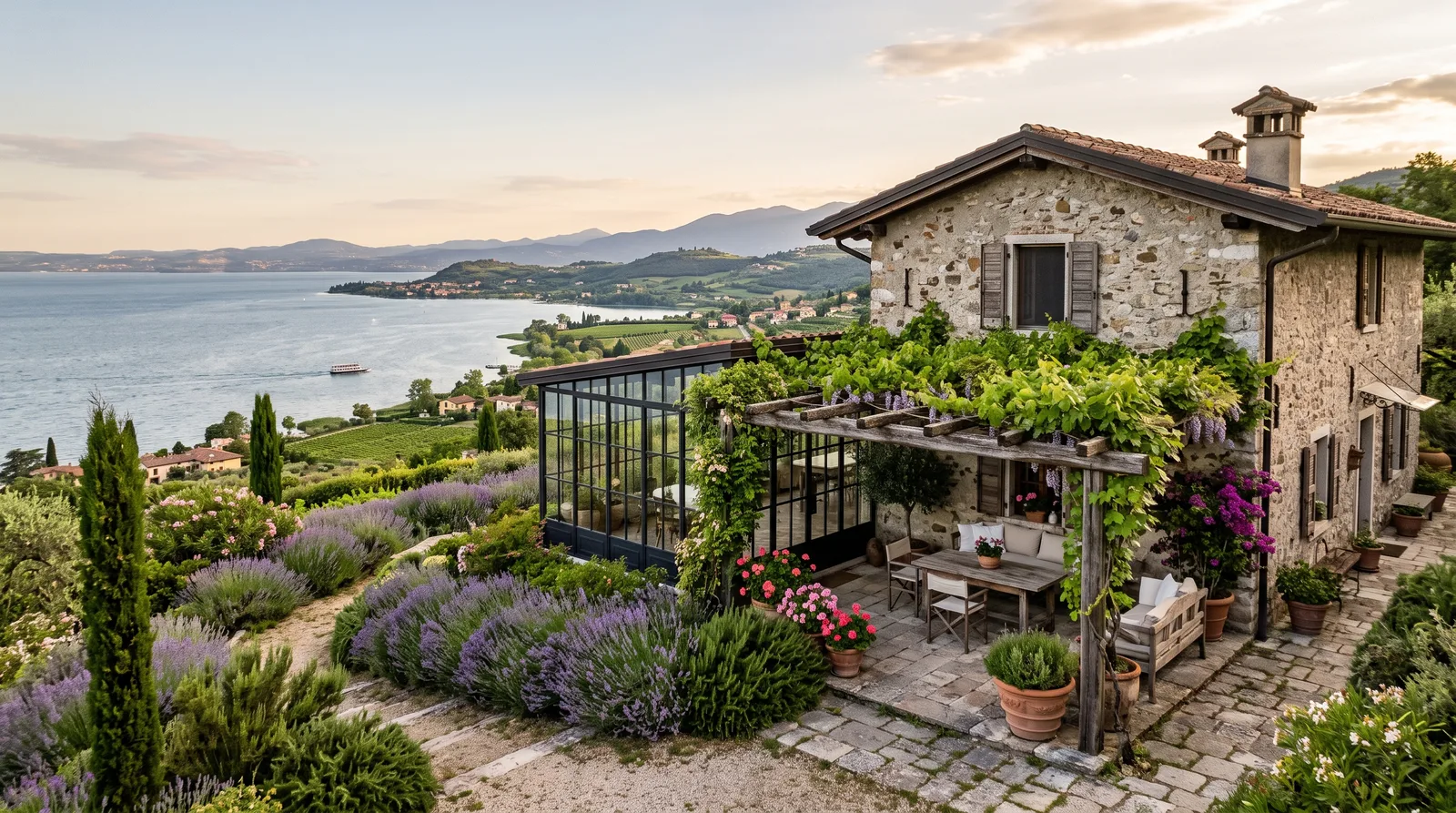
You can sell a house with an unauthorised veranda or canopy, but first find out what kind of discrepancy it is: some can be put right with an application, others must be removed. Do this before you put the house on the market. Otherwise the problem comes to light in front of the notary (notaio), the public official who draws up the deed of sale. By then the buyer is already committed and in a stronger position to ask for a discount.
On Lake Garda this situation is common. Over the years owners have glazed in verandas to gain an extra room and put canopies and pergolas over the garden. Others have turned roof spaces into living space or added pools and garden sheds.
Two kinds of discrepancy: cadastral and planning
- Cadastral discrepancy: the floor plan filed with the cadastre (catasto), the property register used for tax purposes, does not match the house as it is today. Since 2010 the deed of sale must state that they match, so the floor plan must be updated before the final deed of sale (rogito).
- Planning discrepancy: the house does not match what the municipality authorised through the building permits. This is the more serious one, because updating the floor plan at the cadastre does not make legal any work that the municipality never authorised.
What the Salva Casa decree changed
The Salva Casa decree (Decree-Law 69/2024, converted into Law 105/2024) has made some situations easier to put right:
- it widened the construction tolerances for work carried out by 24 May 2024: small differences from the approved plans do not count as unauthorised building work, with wider margins for smaller units
- it introduced a more accessible retrospective regularisation (sanatoria) procedure for partial discrepancies
- under certain conditions, it added removable panoramic glazing on balconies and loggias to the works that need no permit
However, not everything can be regularised. A real extension, an extra room built without a permit or work that conflicts with planning rules may have to be removed.
Free valuation and document checks before your home is listed. I reply personally.
What is my home worth? →Landscape protection on the lake
On Lake Garda there is one more factor: much of the land near the lake is subject to a landscape protection constraint (vincolo paesaggistico). The Code of Cultural Heritage and Landscape protects by law all land within 300 metres of lake shores, and several areas of Lake Garda also have specific constraints. In these areas you need landscape approval (autorizzazione paesaggistica) as well as the municipality’s permit, and there is less scope for regularising work after the event.
So before you promise a buyer that “it can all be sorted out”, the specific case needs to be checked.
How to proceed before you sell
- Gather the building permits for the house from the municipality and the floor plan from the cadastre.
- Compare them with the house as it is, room by room and outside too.
- Work out what kind of discrepancy it is: within tolerance, can be regularised, or must be removed.
- Have a licensed technician prepare the application, with a clear quote.
- Decide on the figures: sometimes it pays to put things right first, sometimes to sell while declaring the situation and reflecting it in the price.
During the free valuation I carry out the preliminary check of the documents myself. If an application is needed, it is signed by an independent licensed technician, with costs agreed in advance.
This article gives general information. Each house must be assessed on its own merits, with the municipality and a licensed technician.
Sources
FIAIP estate agent (membership no. 34185) with a building-surveying background. He works in the Valtenesi and on southern Lake Garda. About me →
 Selling a homeSelling a gifted house on Lake Garda: what changes in 2026
 Selling a homeDocuments to sell a house in Italy: the complete checklist
 MarketLake Garda property prices in October 2026, town by town